Wednesday, June 13, 2012

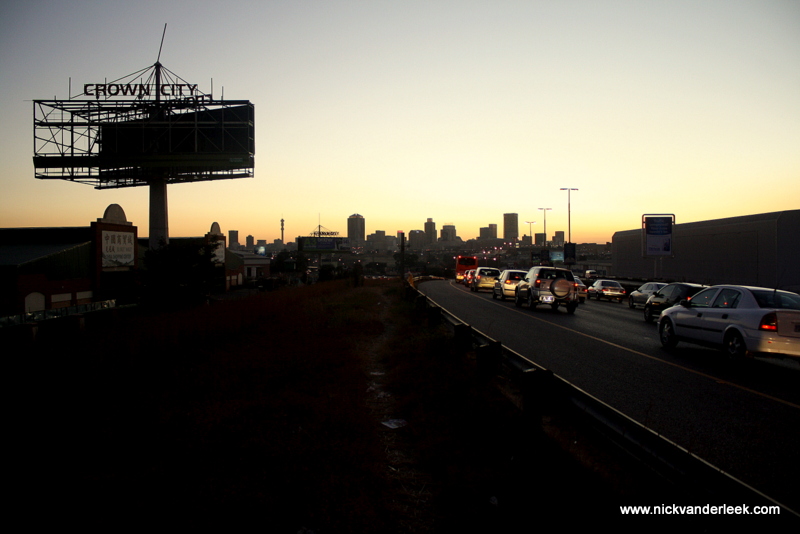
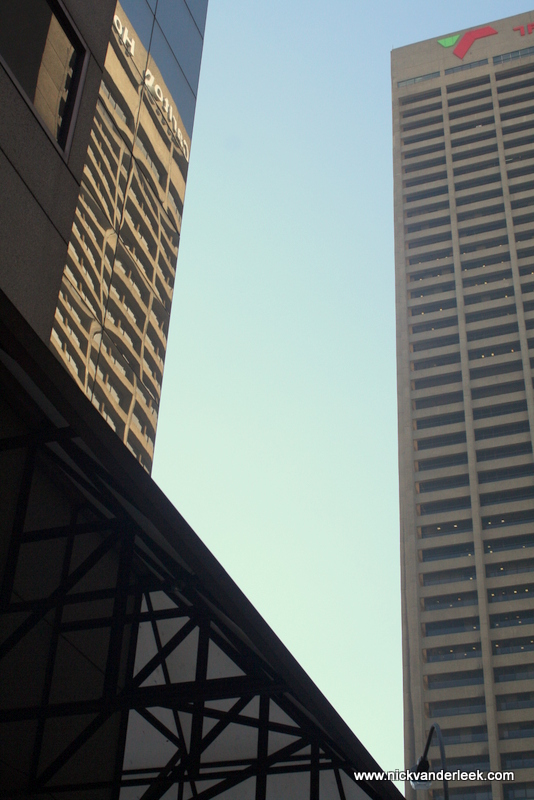
Winter morning in Rosebank, Johannesburg

Rosebank must be one of the few places in South Africa that is actively 'Under Construction'. I used to work in Rosebank in Bierman Road, during the time of the 'one way detour', and just two years later certain precincts have become well nigh unrecognisable.

Opposite the Gautrain Station is a veritable amphitheatre of new buildings, including a new Holiday Inn. Meanwhile, just 15 kilometres away, central Johannesburg - parts of it certainly - seem to be crumbling and disintegrating. Gutted shells of building everywhere.

It's possible that the Gautrain may bring life back into the centre city. I hope so - it's still got a lot going for it. Some of South Africa's most beautiful old buildings for a start.  But Johannesburg still faces major problems in terms of integrating its public transport.  The Gautrain is a good start, but more needs to be done in terms of setting up public transport infrastructure.

GALLERY: Central Johannesburg [send us your pictures today]


Rosebank Station in Pictures

The route from Park Station (Johannesburg's CBD) to Rosebank opened last week. I strongly recommend taking the Gautrain into the CBD as the central city is a confusing warren of one way streets. If you do decide to drive in, make sure you have a navigational gadget with you. If not, budget an extra half hour to fourty five minutes to find the address you're looking for.


Wednesday, June 6, 2012

Global Warming: A Growing Woe

I am of the opinion that the whole so called global warming/climate change issue is too complex a subject to just apportion blame willy-nilly onto the veritable human being, especially as no real workable solutions are put forward by the activists and pundits of global warming/climate change theories.

We live in a self perpetuated and accepted way of life that puts much emphasis on finances and wealth. We mostly all work for a living because of that culture: Those that sponge of the system are looked upon as just that; spongers (why don’t you get a job, you lazy good-for-nothing so-and-so.)

The accepted capitalist system is devoid of emotion and empathy: two human qualities that make life liveable and mostly comfortable. We are becoming automaton of technology and convenience while overlooking the consequences of those actions (I have money, why should I care.) Anyway there are enough charities to contribute too to pacify that nagging conscience.

I am also of the opinion that the capitalist system as we know it is long overdue for a makeover. The fact that the living-wage gap (rich vs. poor) is getting larger by the moment, is enough of an indication that all is not well in the land of finances.

Add to the above equation an emotional subject such as global warming/climate change and a calamity is created at the forefront of the human perception and psyche. The situation is mostly aggravated by the fact that traditional means of incomes are threatened by the call for closure/minimalisation of factories, manufacturing plants and energy utilities – oil is bad, coal is bad, CO² is bad, methane is bad, flatulence is bad, meat is bad, mercury is bad, sugar is bad, cholesterol is bad, obesity is bad, paper is bad, planes are bad, motor vehicles are bad, smoking is bad, fertiliser is bad, et al.

The above-mentioned commodities supply a large percentage of workers with employment/wages on a global basis.

The call for cleaner and renewable energy utilities is adding to this woe for most of the proposed renewable energy generating theories require little human intervention and hands-on skills (not labour intensive); and are expensive to boot.
Developed countries are being asked to provide assistance (money) to developing countries so that they too can implement ‘earth saving’ initiatives. This in itself is seemingly the-proper-thing-to-do, but the underlying catch is that it’s the tax-payers living in the developed countries that will have to foot this noble expense. It must be said that altruism and charity, although seemingly noble, do not fix the underlying problem(s).

So yes, global warming and climate change is a reality of life on earth. It has been for countless of centuries and nothing we do will stave off that inevitably. And yes, our contribution to that ‘inevitably’ can also be counted and measured. And yes, many proposals have been put forward by pundits and activists alike – some more aggressively than others, to what needs and must be done to put off that ‘inevitably.’

What most do not want to take-in is that the problem is not that simple to solve. Those that are at the forefront of the war for change, are mostly gainfully employed or living of the welfare of others, or living on some plot of land (usually wrongly occupied or left behind as an inheritance) growing their own meagre crops feeding themselves and their offspring: close to nature, so to speak.

What most also do not take in is that there are factors outside the control of the veritable human being viz. Volcanic eruptions, solar flare-ups, earth’s passage through the galaxy/universe, moving tectonic plates, etc, that add to the ‘inevitably’ equation.

The ‘legacy’ issue also plays an emotive role in the whole cry for survival i.e. what of the future of my children, what about the poor animals, etc.

And then there is technology; another detractor.

Technology has provided a portion of the human race with tools that have made the acquisition of knowledge easier and cheaper. Technology has also provided a portion of the human race with powers that were previously not easily enacted i.e. freedom of expression (good and bad,) global empathy (good and bad,) power to circumvent despotism, cyber anarchy, etc.

Technology has also provided a portion of the human race with feelings on invincibility and immortality i.e. blogs will live long after one has expired, I can say what I like to whom I like without fear of physical consequence, the power of anonymity, governmental/corporate feel-good marketing campaigns, etc.
And not forgetting the power that technology has granted the giants of human-thought-manipulation i.e. the media, the swaying of public opinion, bending of outcomes to suit a given objective, popularising a certain way of life, sensationalising a happening for the sake of profit, etc.

I have over the past years made it my business to follow the reasoning behind the global warming malady by reading, watching, researching and pensively thinking about the issue at hand (from both sides of the spectrum.) I have also, in view of the few points mentioned in the preceding paragraphs, tried to formulate an opinion that encompasses the problem as a whole, without going off the activist deep-end.

My take on the problems facing the required ‘global warming’ mindset change always comes back to one glaring point: economics. What happens to the petrol industry workers when the petrol plants are done away with? What happens to the meat farmers when people minimalise eating meat? What happens to the livestock when people discontinue feeding on them? What happens to the pilots when people minimise flying? What happens to the motor vehicle industry workers when motor vehicle manufacture is minimised or done away with?

Thus in essence, solve the economics of living and the problem at hand is minimised!

Although the predicament of the human-inflicted global warming danger is a growing one, being self-centred and antagonistic in forcing people to change their sceptical fearful mindsets will not change the internal motivational drives of the human being.

The needs and wants of the people need to be addressed and pacified. Workable solutions have to be constructed in such a way that either alternative gainful employment is generally guaranteed or, that a new means of income generation is devised i.e. doing away with the traditional capitalist way of doing business.
Irrespective of what is said and done, my overriding opinion is that the inevitable will happen and that no amount of political posturing and or activist will and or new-age bluster will change that ‘inevitably.’

It is the now-or-later scenario that remains on the table.

Saturday, May 12, 2012

Online Shopping: What do you think of it?

During the past holiday season, my fancy took me to surfing online shopping sites. A form of consumerism that is becoming popular in leaps and bounds.

All at once I could view, compare and critique items across a wide spectrum of commodities and articles and suppliers; all from the security of my home PC. It was like entering a new world. One where fancies, likes and imagination could be satisfied on the spot. Of course, the money issue did put a damper on the googly eyed adventure. In essence, a reality very much like the traditional way of shopping; except for the armchair bit.

In between the hours spent online, I kept thinking as to the popularity of the medium at hand: Is the South African populace in tune with this medium? Which population demographic finds this electronic shopping experience attractive? What is popular? What about the legal paperwork? Probability of scam attacks and phishing expeditions?

To the first and second question, in speaking to friends and acquaintances, I derived that generally middle to high income households have shopped online: be it tickets to a movie, to a motor car. Most also tried their hand at grocery shopping. Thus the appeal is there.

What was fascinating is how members of the lower income demographic made use of internet cafes (the least of all secure sites) to carry out their order of business (The numbers in question were few but growing.)

The interesting bit came in the guise of some using the information at hand to do comparisons, then going to a physical shop to purchase the selected item in question. Fear of Credit Card information theft and of the faceless entity behind the online façade were the greatest deterrents to actually buying online; specially when substantial payment had to be made (I use one dedicated credit card with low limits to transact across the world wide web.)

Thus more questions came to mind: What would make the online experience more palatable and attractive? What would make the existing system more secure? What would quell the fears a consumer has about shopping online? What impact would the incoming consumer protection act have on the online shopping fraternity (would online service providers have to be RICA’ed or FICA’ed?) Would this action put to the inherent consumer fear of shopping online? Would a ‘comment box’ assist the consumer in voicing their opinions on the service, articles, etc?

The one avenue I found in my searches relates to the commonality of after-sales support more so than the offering of an online shopping portal. In the whole, retail companies offer online after-sales support structures: An operator will contact a consumer after a certain lapse in time to find out about the satisfaction perception. If positive, then all is well, if negative, then how can they assist!?

The above process tends to mostly placate and pacify consumers to the inferred ethos that the company cares.

As a whole, those that can, make use of online shopping to buy low to mid-priced items. The caution factor kicks in where huge payments have to be made. Here the consumer will go to the physical shop and pay there.

The lower income groups use the net more for comparison and availability purposes rather than outright online buying. The picture with the lower income groups is that the mindset is changing as the costs of internet hosting are dropping. The advent of intelligent mobile phones is also helping to change the mindset.

Personally I found the whole exercise insightful and calming: the threats are there, but with a small amount of internet savvy, threats can be managed and overcome.

Will I continue to buy online?

Tuesday, April 24, 2012

USA'

The top 1 percent of U.S. households own nearly twice as much of America's corporate wealth as they did just 15 years ago.
In America today, the average time needed to find a job has risen to a record 35.2 weeks.
clipped from finance.yahoo.com
The 22 statistics detailed here prove beyond a shadow of a doubt that the middle class is being systematically wiped out of existence in America.
The rich are getting richer and the poor are getting poorer at a staggering rate. Once upon a time, the United States had the largest and most prosperous middle class in the history of the world, but now that is changing at a blinding pace.
61 percent of Americans "always or usually" live paycheck to paycheck,
which was up from 49 percent in 2008 and 43 percent in 2007
83 percent of all U.S. stocks are in the hands of 1 percent of the people
66 percent of the income growth between 2001 and 2007 went to the top 1% of all Americans
36 percent of Americans say that they don't contribute anything to retirement savings
A staggering 43 percent of Americans have less than $10,000 saved up for retirement
24 percent of American workers say that they have postponed their planned retirement age in the past year
blog it

Wednesday, January 18, 2012

Photography: A World of Possibilities.

What an interesting hobby photography is. It is everything art is plus more, much more.

I was bitten by this rather ubiquitous art form while doing research for an online shop that is slowly getting itself of the ground. The range of camera paraphernalia that one has to choose from boggles the mind. Boggling the mind is actually putting it mildly. And that is even before one gets to take a photo of something that the minds eye see as emotionally attractive.

On the camera front, the choices are enormous but mostly controlled. Nikon or Cannon, Pentax or Lomo, Sony or Kodak. The variations are quite painful to the novice photographer, but it will mostly come down to quality, price and what effects one desires from the light capturing machine of choice. The most difficult part for me was deciding on the amount of Mega- pixels my prospective camera can capture images at. Lets just say that I am still flabbergasted.

The next catch comes when one needs to choose a lens to attach to the body of camera. Choice is part of life but wow, when it comes to choosing a lens, the possibilities are endless. What usually ends up happening is that one will settle for a middle of the road lens assembly and grow the arsenal from there.

Modern cameras are mostly equipped with various capturing settings of which one will be AUTO. This setting allows one to start shooting immediately - this is unlike the photographic machines of old where patience was a pre-requisite: Visualise the shot, prepare the settings, aim, shoot and hope that the settings were befitting the shot at hand; or that the roll-of-film was not defective. Then there was the developing processes to account for…

Once I settled on a camera with , the correct Mega-pixels and a lens, I needed to choose a camera case, a memory card (to extend the amount of photos I can take in one sitting,) a flash unit and a tripod; and not forgetting the blasted batteries (normal or rechargeable!?)

Finally I paid and left the shop full of apprehension and trepidations all rolled into one. Where to begin? What to Shoot? Did I buy the right camera? Must get the batteries charged…endless thoughts of doubts and misgivings.

But I learnt quickly. The best way to learn is to shoot, shoot and shoot some more. Having digital technology at one’s beck-and-call means that a photograph can be viewed immediately and settings adjusted on the spot, thus alleviating the patience paradox of old.


Now what do I do with my Kodak mik-and-druk?

Friday, July 9, 2010

South Africa's criminals wait World Cup out on the bench

Only 172 cases have come to the World Cup courts, the noise of the gavels no match for the vuvuzelas. The scorecard, as tallied by the Justice Ministry through July 5, reads: 104 convictions, 7 acquittals, 28 withdrawn or dismissed, 33 pending.
The World Cup case that drew the most attention was hardly a sin that would startle the squeamish. Two Dutch women were accused of illegal advertising after they entered a stadium wearing orange mini-dresses and leading about 30 other young females clad exactly the same. At the hemline, visible at the upper thigh, was the small purple logo of the Bavaria Brewery.

SHOOT: So let's see this level of no nonsense policing all the time.
clipped from www.nytimes.com


JOHANNESBURG — It has been small stuff, mostly. A Swiss man threw a glass of whisky at a Dutch camera crew. A homeless South African stole a blanket from a tourist’s unlocked minivan. A friend of Paris Hilton’s was caught with a marijuana cigarette. A hotel’s cleaning crew helped themselves to underwear belonging to the English soccer team.


A cataclysmic wave of violent crime in South Africa, the fear of so many World Cup killjoys, has simply not occurred. No wave, barely a ripple. The criminals have put in a more indifferent showing than even the French players.


“With increased police activity everywhere, the criminals have been afraid to come out,” said a police spokesman, Col. Eugene Opperman, allowing that lawbreakers may simply have forgone their misdeeds to watch the games.


By “everywhere,” he meant places tourists were likely to go: the stadiums, the nightclubs, the upscale malls — the focus of 44,000 police officers.

 blog it

Sunday, June 20, 2010

Let's keep up the standards of service delivery, public transport - ZILLE

Zille said "immutable deadlines" now needed to be set up in terms of addressing South Africa's social problems.

"If we can learn this lesson from the World Cup, and apply it in a way that does not erode democracy, it will have been more than worth it."

SHOOT: It shows you that we can up our game when it comes to policing and enforcing, and also, we must.
clipped from www.sport24.co.za

Johannesburg - The lessons of the FIFA Soccer World Cup can be used to improve the justice system and service delivery, Democratic Alliance Leader Helen Zille said on Sunday.

"The lessons of the World Cup extend far beyond sport," she said, citing the example of the 56 dedicated courts set up to deal with cases for the sporting spectacular.

"The results have, apparently, been astounding.

"Within four days of kick-off, 20 cases had been brought before the special courts and four finalised. At this rate, the special World Cup courts will finalise five times more cases per month than normal courts."

Zille said an equally "dramatic" example of rapid delivery was the less than four years it took to build the Cape Town stadium.

"In contrast, a proposed housing development, initiated at the same time as the stadium, is unlikely to be completed until 2013."

Zille said the difference lay with the fact that for these projects there was an "unchangeable deadline".

 blog it

Thursday, June 17, 2010

During SWC South Africa's infrastructure fails

The government has urged fans to avoid road congestion by using public transport, which received a R40bn upgrade ahead of the tournament.

SHOOT: There's not much in the news about aggrieved fans stranded until 3am on trains with no electricity but you can bet it was a miserable experience. Yes we built stadiums, but we were really ready to host these games when we can't even keep the lights on?
clipped from www.sport24.co.za
Metrorail trains were forced to switch from electric to steam locomotives because of the power cut, delaying the last two trains by between two and three hours with the last fans only arriving at 03:30, said Tumisang Kgaboesele, head of the Passenger Rail Agency of South Africa.
"We are very concerned. We have already apologised to our customers," he told AFP.
Metrorail ferried 13 600 people to and from Pretoria's Loftus Versfeld stadium on Wednesday for the Group A match.
South Africa suffered national blackouts in January 2008 that raised alarms about the nation's ageing electricity system.
The 10 World Cup stadiums each have generators to ensure power supplies during matches.
 blog it

Monday, June 14, 2010

Strong Earthquake Rocks Johannesburg

SHOOT: Crazy!
clipped from www.news24.com
Johannesburg - An earthquake that measured 4.3 on the Richter scale was felt along the West Rand and parts of Johannesburg on Monday afternoon, the Council for Geosciences said.
The quake, recorded just before 14:00, was relatively stronger than those usually measured along the mining belt, seismologist Ian Saunders said.
 blog it

Saturday, June 12, 2010

Crime in South Africa during the #Fifa World Cup - so far

SHOOT: The most shocking is that while Uruguay is playing their game, their stuff is being swiped in their hotel rooms. Disgusting. These hotels must also be reported and blacklisted after the game.
clipped from www.sport24.co.za
Cape Town - The Mother City's special World Cup Magistrate's Court dealt with its first three cases this week, including a theft from a Japanese tourist in a police station, police said on Thursday.
The theft took place at the Caledon Square station in the city centre on Tuesday, police head of 2010 operations in the Western Cape, Major-General Robbie Roberts, said.
"The tourist was in the CSC (community service centre) in Cape Town police station and he left his bag unattended.
"He went up to the third floor and when he returned, he found that his bag was gone."
clipped from www.news24.com

Journo robbers jailed for 15yrs

A Nigerian and a Zimbabwean man have been jailed for 15 years for robbing three foreign journalists in Magaliesburg.


  • Chinese journalists robbed

  • Uruguay team robbed at hotel
  • 6 held for robbing soccer fan

    Six people who allegedly robbed a hotel in Mpumalanga and held up a Chilean soccer fan have been arrested in White River, police say.

     blog it

    Monday, June 7, 2010

    Warm-up match stampede a wake-up call

    "We have security plans that are there," said Col. Hangwani Mulaudzi, another police spokesman. "I think this is one of those isolated cases where we did not anticipate the large number of people who would be interested in this game."

    SHOOT: I think SA will be caught napping in a bunch of areas, unfortunately. It's not really a 1st world country any more.
    clipped from news.yahoo.com
    South African Police officers patrol as the bus of France soccer players arrives for a training session in Knysna, South Africa, Monday, June 7, 2010.

    JOHANNESBURG – No one was killed. Most of the injuries were minor. Yet a stampede at a supposedly low-key warm-up match set off alarms for World Cup organizers as they reassessed their plans for keeping fervent sellout crowds under control.

    Hopes for a safe tournament remain high, officials said Monday. But the scary incident at a Nigeria-North Korea exhibition match was a stark reminder of past stadium disasters, in Africa and elsewhere, that have been one of soccer's recurring and deadly legacies.

    "This is like an alarm clock," FIFA president Sepp Blatter said. "This will not happen in any match of the World Cup — you can be assured."

    In Orkney, South Africa, 42 fans were killed in a melee and stampede at a 1991 match between the archrival Orlando Pirates and Kaizer Chiefs. Ten years later, when those same teams met at Ellis Park in Johannesburg, 43 people were killed and 155 injured as fans — many arriving without tickets — tried to push into the overcrowded stadium.

     blog it

    Tuesday, June 1, 2010

    41 prisoners escape South African prison - most ever

    SHOOT: I'm sure tourists will be very reassured by this. South Africa is an incredibly safe country with decent police and government officials - NOT!
    clipped from www.buanews.gov.za

    Pretoria - A mass escape by prisoners at the Harrismith Correctional Centre on Monday has led to the summarily dismissal of two Correctional Services officials who were linked to the escape.

    The dismissals follow a prompt fact finding visit to the facility by Correctional Services Minister, Nosiviwe Mapisa-Nqakula - following an escape last night of 41 awaiting trial detainees.

    According to the department, Monday's escape was the biggest single escape from a correctional facility in many years.

    Mapisa-Nqakula said breaching of security cannot be tolerated because South Africans and Parliament expect not just the reduction of escapes, but no escapes from Correctional Centres.

    She said the President's directive is for all departments of the Criminal Justice System to ensure that "all people in South Africa are and feel safe.'

    The minister praised the South African Police Services for making quick and good progress in recapturing eight of the 41 escapees within a few hours after their escape.
     blog it

    Monday, May 31, 2010

    Teaching Work Values to Children of Wealth

    “Seriously middle-class families have said for a long time that the investment I’ve made in you is giving you a good education and then you’re on your own,” Ms. Godfrey said. “But now these families are realizing they have a great education, but yikes, it’s tough for them to be on their own. Now it’s not how much money you have, but how big is your network and how can you connect them.”

    SHOOT: I think parents can learn a lot from this.
    clipped from www.nytimes.com


    GOOD HELP So what is the right way to help a child struggling to find a job or a career? Ms. Godfrey said it could be difficult to get children started, or what she calls “launched.”


    “A year ago, when we started to do fairly serious work on the launch process, I thought we were dealing with families who had slackers,” she said. “The more we got into it, the more we realized that these were kids who are educated but are having a tough time getting into a purposeful path that will help them maintain their lifestyle.”


    She urges families to set two goals: get children living without subsidies and put them on a career track. “Those families that treat their kids’ launch like any other endeavor are having the most success,” she said.


    This means parents and children need to discuss expectations. If financial help is involved, it cannot be infinite and that must be explained. But most of all, parents have to realize there is more to be done than just educating their children.

     blog it

    Saturday, May 22, 2010

    Use #WC2010 when you tweet about the World Cup

    Bangs predicts there will be more mashups and parodies during the World Cup as well as videos examining the political implications of an African nation hosting the tournament for the first time.

    SHOOT: CNN reckons South Africa's World Cup will drive record social media traffic levels. Sounds about right.
    clipped from edition.cnn.com
    [The World Cup] will eclipse everything we have seen so far including the U.S. elections and the Super Bowl
    --Robin Sloan, Twitter

    "Our notion is that [the World Cup] will eclipse everything we have seen so far [on Twitter] including the U.S. election, the Oscars or the Super Bowl, simply because it is so international," Robin Sloan, a Twitter employee that works on media partnerships, told CNN.

    And during the last few days of the tournament, he expects World Cup discussion to "absolutely take over Twitter." So far, many fans have been using the Twitter hash tag#WC2010 when they tweet about the World Cup.

    In 2006, after French player Zinedine Zidane head-butted Marco Materazzi of Italy, hundreds of videos parodying the play were posted on YouTube. Some videos placed Zidane in a video game while others showed him in well-known movie scenes.

     blog it

    Tuesday, May 18, 2010

    14.5°C - April 2010 was the hottest ever recorded

    SHOOT: The hottest ever? I wonder if that has anything to do with that thing people talk about, what is it? That funny theory that was going around until a while back. Global warming or something? I wonder if the hottest ever April has anything to do with us, you know, driving around every day. *Shrugs shoulders and turns on the TV, nothing to do with me. What else is news?*
    clipped from www.news24.com

    Geneva - April 2010 was the hottest ever recorded, with an average temperature of 14.5°C, the UN weather agency said on Tuesday.

    Citing data from the US National Oceanic and Atmospheric Administration, the World Meteorological Organisation said that the average temperature on both land and ocean this April reached 0.76°C above that of the 20th century average of 13.7°C.

    A statement from the US agency noted that warmer-than-normal conditions "dominated the globe, with the most prominent warmth in Canada, Alaska, the eastern United States, Australia, South Asia, northern Africa and northern Russia".

    Weather records go as far back as 1880.

     blog it

    Monday, May 17, 2010

    Should football fans fear for their lives at the World Cup?

    "While crime might be going down, it is [often] extremely violent, armed robberies, hijackings. It is very in your face, it is very gruesome. The robbers will come in and not only attack a couple, [but] rape the wife, and severely assault the husband.

    "People are worried about what the government is trying to feed them. The violence associated with crime is increasing."

    SHOOT: I'm a South African, this was my take on the same question > http://www.nickvanderleek.com/2009/03/just-how-dangerous-is-south-africa.html
    clipped from news.bbc.co.uk
    South Africa policeman
    With a multitude of tourists heading to South Africa for the World Cup, a question hangs on many lips: how dangerous is the country?

    South Africa is a place where a lot of violent crime happens.

    That much is hard to dispute.

    Each day an average of nearly 50 people are murdered.

    In addition to these 18,000 murders each year, there are another 18,000 attempted murders.

    Graph comparing murder rates in UK and South Africa

    Kwa Mashu, a township outside Durban in KwaZulu-Natal, has the unfortunate honour of being dubbed South Africa's murder capital by the media, with 300 last year. It took the unwanted honour from Nyanga, a township outside Cape Town.

    "There are extremely high rates of unemployment in some areas. All of this leads to a large element of frustration. Often this is the thing that sparks violence.

    Police in a stadium

    Of the 18,438 house robberies in South Africa last year, 8,122 were in the province of Gauteng, which includes Johannesburg. The likelihood of being a victim is twice the national average there.

     blog it

    Saturday, May 15, 2010

    New York Times editor in chief: How I plan to charge for online content

    SHOOT: Intwisting. Well I'm sure all the bloggers out there welcome the news that media companies plan to charge for access to their exceptional journalism. But here's an idea. When these companies are charging for online content, what it stopping bloggers from going out, buying the newspapers, and summarising these stories on their own sites, for free, in their own words?
    clipped from venturebeat.com

    The New York Times’ slow-cooked plan to charge some readers for some of its online content will be put into place in January of next year, editor in chief Bill Keller told other journos at a dinner in New York on Thursday night.

    The Times’ previous attempt to charge for content, TimesSelect, was canceled later that year because too few subscribers had signed up for what was basically a premium content package. Most TimesSelect content was what newspaper editors categorize as commentary or opinion, rather than news reporting. People were uninterested in paying an extra $50 per year to read the Times’ columnists.

    Chances are Keller and company are still trying to calculate exactly how much to give away, and how much to charge for greater access. Without those numbers, the only safe prediction is that they won’t start with a high bar to access. Better to start with a lenient setting that blocks few readers, then ratchet it up to see what the market will bear.

     blog it